FRPT 2026: from FLASH research to clinical translation
At FRPT 2026, from the ElectronFlash research platform to the Chc FlashPrime, SIT is turning FLASH into a medical device ready for clinical use.
Why is nobody treating patients with FLASH? A few tens of patients have in fact been treated, with protons and with electrons, but always within clinical investigations and on machines adapted for the purpose. The sparing of normal tissue at ultra-high dose rates is established preclinically; what is still missing is a medical device able to deliver it. The question is therefore shifting from whether the effect exists to how it can be delivered in a controlled, safe and clinically usable way.
Answering it requires rethinking what is prescribed. Dose remains necessary, but it is no longer sufficient: the outcome also depends on the temporal structure of the beam, that is, on dose per pulse, pulse duration, repetition frequency and number of pulses. A research platform can vary these parameters at will. A medical device must do something different: declare a single operating point, monitor it and hold it, changing it only through a regulatory path. This step, from exploring to declaring, is what separates FLASH research from clinical translation, and it is the step SIT is taking.
SIT’s research on ultra-high dose rate electron beams has been developed on ElectronFlash, a dedicated platform that sets every parameter of the beam structure independently and was designed to IEC 60601-2-1, so that the radiobiology it produces is interpretable. This know-how has been translated into the Chc FlashPrime, a medical device that monitors all parameters pulse by pulse, with interlocks, around one declared operating point per energy and applicator. The setting is not accidental: in intraoperative electron radiotherapy the patient already receives a single high dose in a single field, so FLASH changes one variable only, the delivery time. With CE marking pending and expected shortly, the Chc FlashPrime will be among the first electron linear accelerators able to operate in both conventional IORT and FLASH modes, placing SIT among the few companies to have brought a FLASH device this close to clinical use.
The FLASH Radiotherapy and Particle Therapy Conference (FRPT), featuring Spatially Fractionated Radiation Therapy, taking place in Lisbon, Portugal, from 2 to 5 December 2026, is the natural setting in which to present this step. SIT’s commitment, however, goes beyond the development of its own devices: it extends to the collaborative projects through which FLASH and spatially fractionated radiotherapy are being carried from technology to clinical validation.
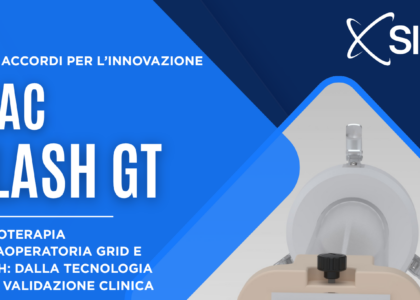
A key example is LIAC FLASH GT, a research and development project funded by the Italian Ministry of Enterprises and Made in Italy (MIMIT) under the Accordi per l’Innovazione and coordinated by SIT. It addresses spatially fractionated radiotherapy, one of the central themes of FRPT, by developing an intraoperative electron system that integrates GRID and FLASH irradiation and follows it through to preclinical and clinical validation.
Meet SIT in Lisbon
At FRPT we will be at Tabletop 04, available for meetings throughout the conference. We look forward to discussing clinical translation of FLASH with clinical centers, researchers, and prospective partners and distributors.
To schedule an appointment or request information:
Web: soiort.com/contact-us – Email: info@soiort.com